
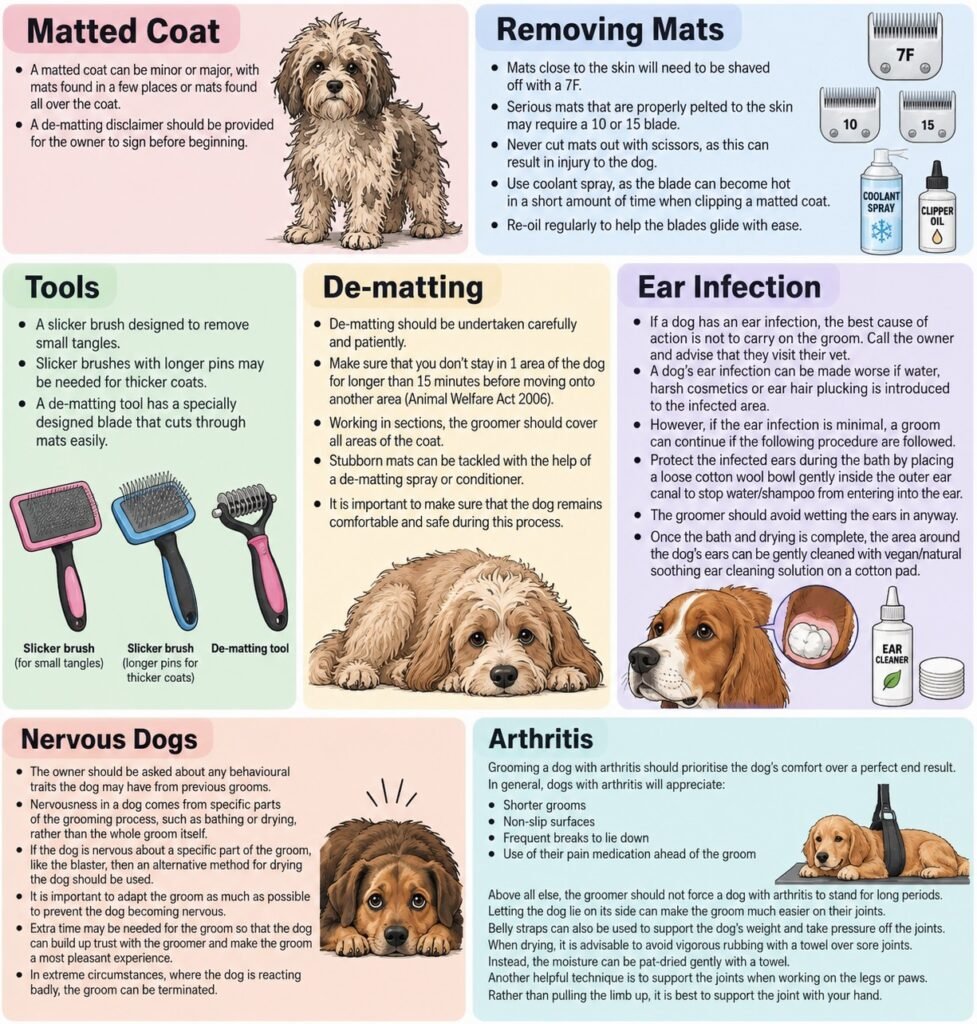
Matted Coat
A matted coat can be minor or major, with mats found in a few places or mats found all over the coat. A de-matting disclaimer should be provided for the owner to sign before beginning.
Removing Mats
- Mats close to the skin will need to be shaved off with a 7F.
- Serious mats that are properly pelted to the skin may require a 10 or 15 blade.
- Never cut mats out with scissors, as this can result in injury to the dog.
- Use coolant spray, as the blade can become hot in a short amount of time when clipping a matted coat.
- Re-oil regularly to help the blades glide with ease.
Tools
- A slicker brush designed to remove small tangles.
- Slicker brushes with longer pins may be needed for thicker coats.
- A de-matting tool has a specially designed blade that cuts through mats easily.
De-matting
De-matting should be undertaken carefully and patiently.
Make sure that you don’t stay in 1 area of the dog for longer than 15 minutes before moving onto another area (Animal Welfare Act 2006).
Working in sections, the groomer should cover all areas of the coat.
Stubborn mats can be tackled with the help of a de-matting spray or conditioner.
It is important to make sure that the dog remains comfortable and safe during this process.
Ear Infection
If a dog has an ear infection, the best cause of action is not to carry on the groom. Call the owner and advise that they visit their vet.
A dog’s ear infection can be made worse if water, harsh cosmetics or ear hair plucking is introduced to the infected area.
However, if the ear infection is minimal, a groom can continue if the following procedure are followed.
- Protect the infected ears during the bath by placing a loose cotton wool bowl gently inside the outer ear canal to stop water/shampoo from entering into the ear.
- The groomer should avoid wetting the ears in anyway.
- Once the bath and drying is complete, the area around the dog’s ears can be gently cleaned with vegan/natural soothing ear cleaning solution on a cotton pad.
Nervous Dogs
The owner should be asked about any behavioural traits the dog may have from previous grooms.
Nervousness in a dog comes from specific parts of the grooming process, such as bathing or drying, rather than the whole groom itself.
If the dog is nervous about a specific part of the groom, like the blaster, then an alternative method for drying the dog should be used.
It is important to adapt the groom as much as possible to prevent the dog becoming nervous.
Extra time may be needed for the groom so that the dog can build up trust with the groomer and make the groom a most pleasant experience.
In extreme circumstances, where the dog is reacting badly, the groom can be terminated.
Arthritis
Grooming a dog with arthritis should prioritise the dog’s comfort over a perfect end result.
In general, dogs with arthritis will appreciate:
- Shorter grooms
- Non-slip surfaces
- Frequent breaks to lie down
- Use of their pain medication ahead of the groom
Above all else, the groomer should not force a dog with arthritis to stand for long periods.
Letting the dog lie on its side can make the groom much easier on their joints.
Belly straps can also be used to support the dog’s weight and take pressure off the joints.
When drying, it is advisable to avoid vigorous rubbing with a towel over sore joints.
Instead, the moisture can be pat-dried gently with a towel.
Another helpful technique is to support the joints when working on the legs or paws.
Rather than pulling the limb up, it is best to support the joint with your hand.
