
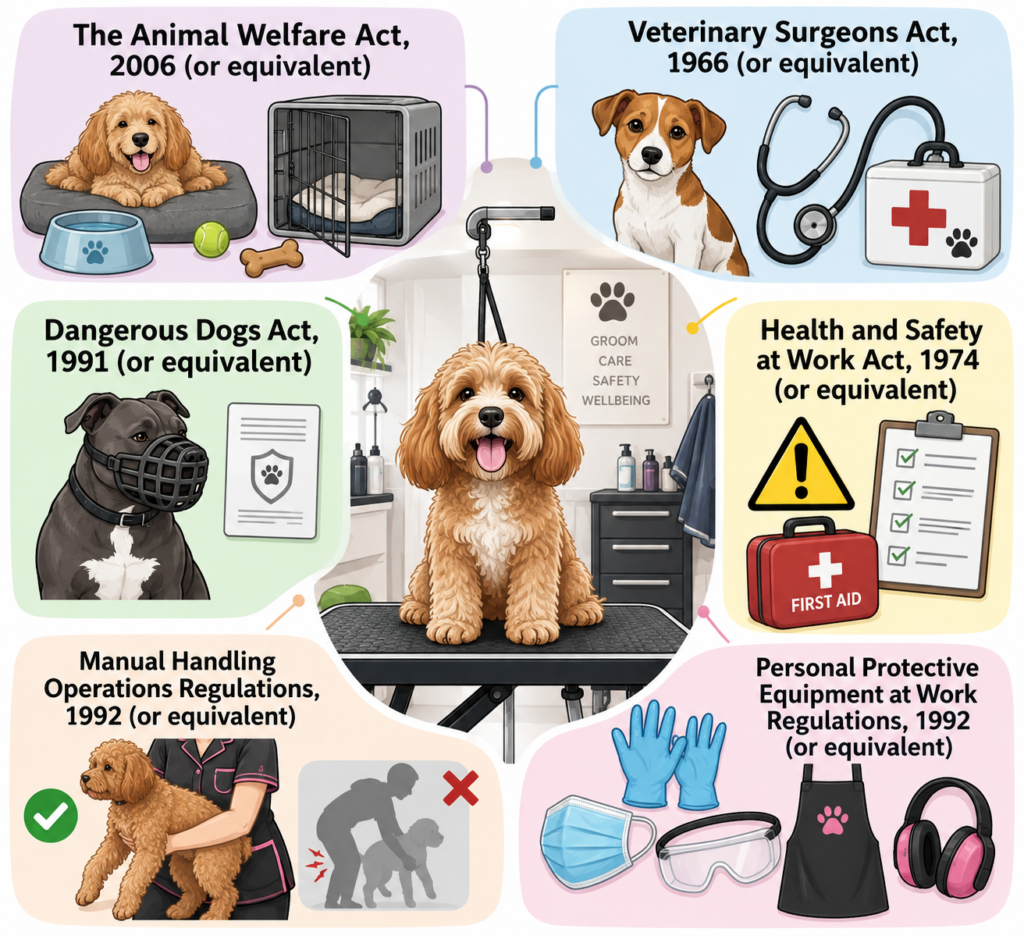
The Animal Welfare Act, 2006 (or equivalent)
We would ensure every dog has a clean, safe and secure environment and is not housed with dogs from other households, reducing stress and the risk of disease transmission.
Each dog would have regular toilet breaks and access to fresh drinking water throughout the groom. we would also ensure they have rest periods so they can have a break from the grooming process.
If a dog is placed in a crate, it would be the correct size and suitable for the dog’s needs and welfare. The crate would be kept clean and comfortable.
Treats would only be given with the owner’s permission, taking into consideration any dietary requirements or allergies.
Any accidents or injuries would be addressed immediately and, if necessary, the dog would be referred to a vet.
Veterinary Surgeons Act, 1966 (or equivalent)
We understand that we are not qualified to diagnose conditions or provide veterinary advice. we will not provide veterinary procedures and will refer any health concerns or injuries to the owner so they can make the decision to take their dog to the vet.
As a trained first aider, we will provide immediate first aid if required.
Dangerous Dogs Act, 1991 (or equivalent)
We would ensure the Dangerous Dogs Act 1991 is met by not accepting any dog listed under the Act unless it is legally permitted and covered by our insurance.
We would ensure that we are fully aware of the dog’s breed and characteristics before accepting the dog onto a grooming schedule.
Where legally required, the dog would be required to wear a muzzle throughout the groom, such as when the dog is out in public under the requirements of the Act.
The Health and Safety at Work Act, 1974 (or equivalent)
We would ensure that the Health and Safety at Work Act 1974 is met by carrying out regular health and safety training and ensuring safe working practices are followed.
PPE would be provided where necessary, and regular checks would be carried out on equipment to make sure it is maintained and kept in a safe and working condition.
Warning signs will be present where appropriate to highlight potential hazards.
A first aid kit would also be available on site to deal with any accidents and injuries promptly.
Manual Handling Operations Regulations, 1992 (or equivalent)
We would ensure that manual handling is avoided where possible. However, if lifting a dog is necessary, we would assess the risk and use safe lifting techniques. If the dog is too large to lift safely on our own, another person would be required to assist.
Personal Protective Equipment at Work Regulations, 1992 (or equivalent)
Suitable PPE would be provided where required, and staff would be fully trained in how to use, clean, maintain and safely store it.
Regular training on PPE would be provided to ensure that knowledge and training remain up to date.
PPE would also be regularly checked to make sure it is kept in a safe and usable condition.
