
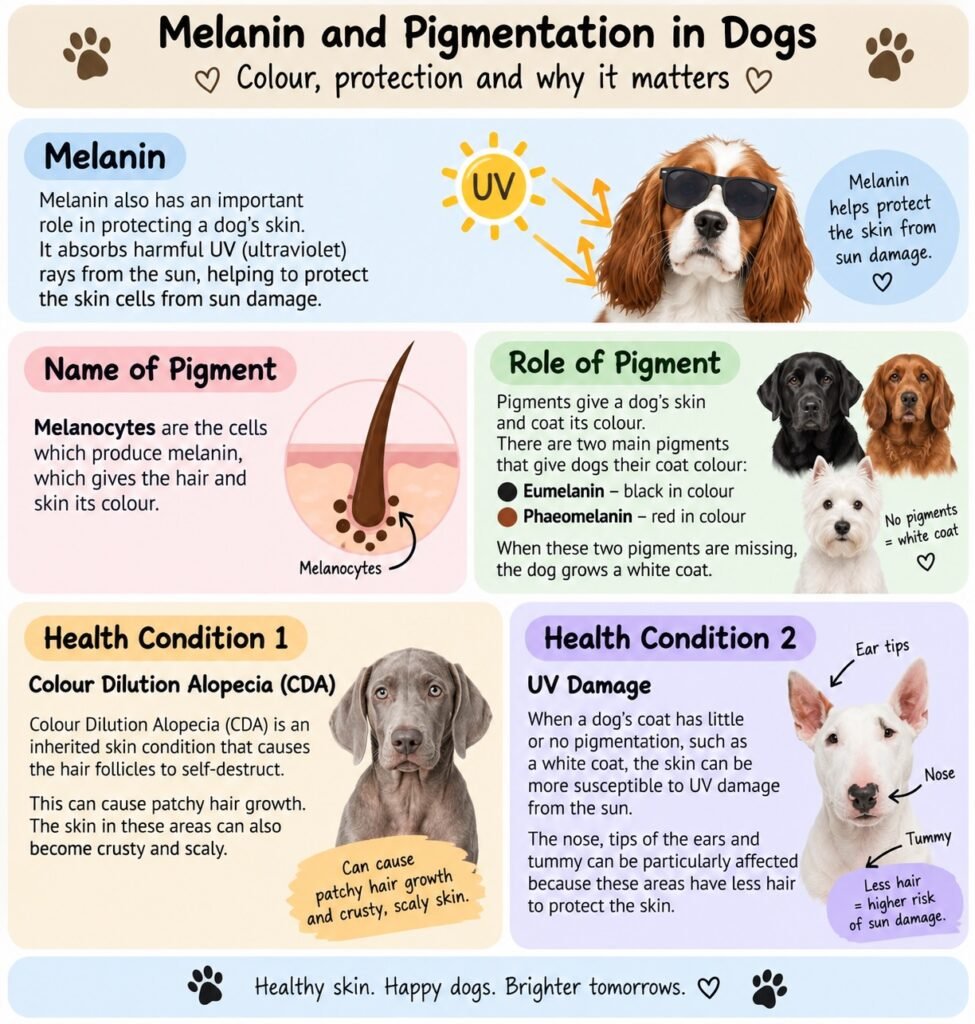
Melanin
Melanin has an important role in protecting a dog’s skin. It absorbs harmful UV (ultraviolet) rays from the sun, helping to protect the skin cells from sun damage.
Name of Pigment
Melanocytes are the cells that produce melanin, which gives the hair and skin its colour.
Role of Pigment
Pigments give a dog’s skin and coat its colour.
There are two main pigments that give dogs their coat colour:
- Eumelanin – black in colour
- Phaeomelanin – red in colour
When these two pigments are missing, the dog grows a white coat.
Health Condition 1 – Colour Dilution Alopecia (CDA)
Colour Dilution Alopecia (CDA) is an inherited skin condition that causes the hair follicles to self-destruct.
This can cause patchy hair growth. The skin in these areas can also become crusty and scaly.
Health Condition 2 – UV Damage
When a dog’s coat has little or no pigmentation, such as a white coat, the skin can be more susceptible to UV damage from the sun.
The nose, tips of the ears and tummy can be particularly affected because these areas have less hair to protect the skin.
