
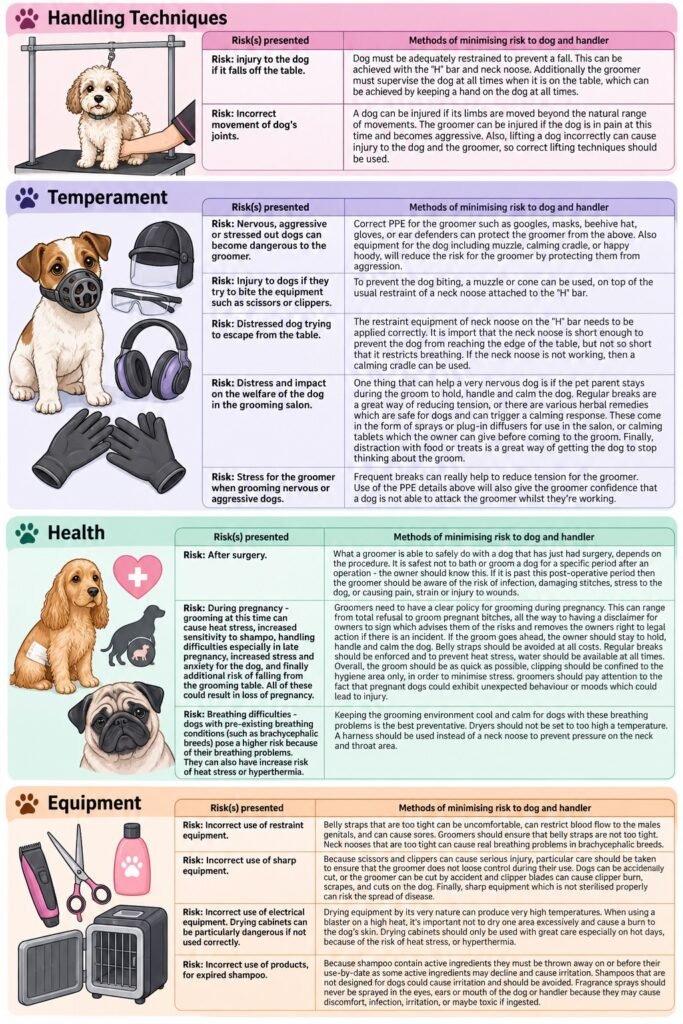
Handling Techniques
Risk:
Injury to the dog if it falls off the table.
Mitigation:
Dog must be adequately restrained to prevent a fall. This can be achieved with the ‘H’ bar and neck noose. Additionally the groomer must supervise the dog at all times when it is on the table, which can be achieved by keeping a hand on the dog at all times.
Risk:
Incorrect movement of dog’s joints.
Mitigation:
A dog can be injured if its limbs are moved beyond the natural range of movements. The groomer can be injured if the dog is in pain at this time and becomes aggressive. Also, lifting a dog incorrectly can cause injury to the dog and the groomer, so correct lifting techniques should be used.
Temperament
Risk:
Nervous, aggressive or stressed out dogs can become dangerous to the groomer.
Mitigation:
Correct PPE for the groomer such as googles, masks, beehive hat, gloves, or ear defenders can protect the groomer from the above. Also equipment for the dog including muzzle, calming cradle, or happy hoody, will reduce the risk for the groomer by protecting them from aggression.
Risk:
Injury to dogs if they try to bite the equipment such as scissors or clippers.
Mitigation:
To prevent the dog biting, a muzzle or cone can be used, on top of the usual restraint of a neck noose attached to the ‘H’ bar.
Risk:
Distressed dog trying to escape from the table.
Mitigation:
The restraint equipment of neck noose on the ‘H’ bar needs to be applied correctly. It is import that the neck noose is short enough to prevent the dog from reaching the edge of the table, but not so short that it restricts breathing. If the neck noose is not working, then a calming cradle can be used.
Risk:
Distress and impact on the welfare of the dog in the grooming salon.
Mitigation:
One thing that can help a very nervous dog is if the pet parent stays during the groom to hold, handle and calm the dog. Regular breaks are a great way of reducing tension, or there are various herbal remedies which are safe for dogs and can trigger a calming response. These come in the form of sprays or plug-in diffusers for use in the salon, or calming tablets which the owner can give before coming to the groom. Finally, distraction with food or treats is a great way of getting the dog to stop thinking about the groom.
Risk:
Stress for the groomer when grooming nervous or aggressive dogs.
Mitigation:
Frequent breaks can really help to reduce tension for the groomer. Use of the PPE details above will also give the groomer confidence that a dog is not able to attack the groomer whilst they’re working.
Health
Risk:
After surgery.
Mitigation:
What a groomer is able to safely do with a dog that has just had surgery, depends on the procedure. It is safest not to bath or groom a dog for a specific period after an operation – the owner should know this. If it is past this post-operative period then the groomer should be aware of the risk of infection, damaging stitches, stress to the dog, or causing pain, strain or injury to wounds.
Risk:
During pregnancy – grooming at this time can cause heat stress, increased sensitivity to shampoo, handling difficulties especially in late pregnancy, increased stress and anxiety for the dog, and finally additional risk of falling from the grooming table. All of these could result in loss of pregnancy.
Mitigation:
Groomers need to have a clear policy for grooming during pregnancy. This can range from total refusal to groom pregnant bitches, all the way to having a disclaimer for owners to sign which advises them of the risks and removes the owners right to legal action if there is an incident. If the groom goes ahead, the owner should stay to hold, handle and calm the dog. Belly straps should be avoided at all costs. Regular breaks should be enforced and to prevent heat stress, water should be available at all times. Overall, the groom should be as quick as possible, clipping should be confined to the hygiene area only, in order to minimise stress. groomers should pay attention to the fact that pregnant dogs could exhibit unexpected behaviour or moods which could lead to injury.
Risk:
Breathing difficulties – dogs with pre-existing breathing conditions (such as brachycephalic breeds) pose a higher risk because of their breathing problems. They can also have increase risk of heat stress or hyperthermia.
Mitigation:
Keeping the grooming environment cool and calm for dogs with these breathing problems is the best preventative. Dryers should not be set to too high a temperature. A harness should be used instead of a neck noose to prevent pressure on the neck and throat area.
Equipment
Risk:
Incorrect use of restraint equipment.
Mitigation:
Belly straps that are too tight can be uncomfortable, can restrict blood flow to the males genitals, and can cause sores. Groomers should ensure that belly straps are not too tight. Neck nooses that are too tight can cause real breathing problems in brachycephalic breeds.
Risk:
Incorrect use of sharp equipment.
Mitigation:
Because scissors and clippers can cause serious injury, particular care should be taken to ensure that the groomer does not loose control during their use. Dogs can be accidentally cut, or the groomer can be cut by accident and clipper blades can cause clipper burn, scrapes, and cuts on the dog. Finally, sharp equipment which is not sterilised properly can risk the spread of disease.
Risk:
Incorrect use of electrical equipment. Drying cabinets can be particularly dangerous if not used correctly.
Mitigation:
Drying equipment by its very nature can produce very high temperatures. When using a blaster on a high heat, it’s important not to dry one area excessively and cause a burn to the dog’s skin. Drying cabinets should only be used with great care especially on hot days, because of the risk of heat stress, or hyperthermia.
Risk:
Incorrect use of products, for expired shampoo.
Mitigation:
Because shampoo contain active ingredients they must be thrown away on or before their use-by-date as some active ingredients may decline and cause irritation. Shampoos that are not designed for dogs could cause irritation and should be avoided. Fragrance sprays should never be sprayed in the eyes, ears or mouth of the dog or handler because they may cause discomfort, infection, irritation, or maybe toxic if ingested.
